


As markets across Europe move beyond early Open Banking frameworks, the conversation around AI and Open Finance is no longer about potential – it’s about implementation. For emerging markets like Moldova, this creates both an opportunity to accelerate and a challenge to avoid mistakes seen in more mature markets.
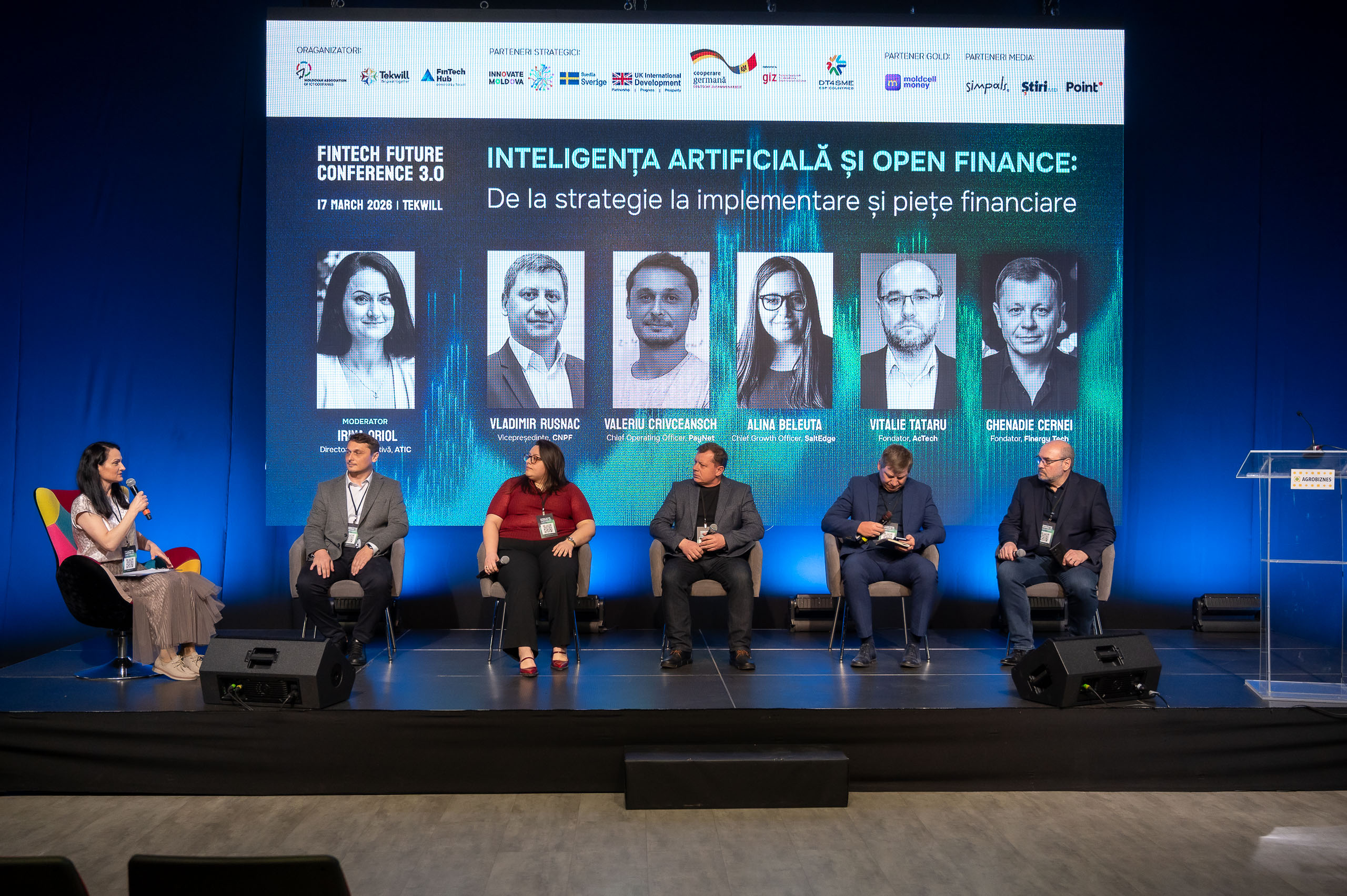
At the recent Fintech Future Conference 3.0, held in Chisinau, Moldova, industry leaders gathered to discuss how these technologies are transforming the financial infrastructure and business models.
Alina Beleuta, Chief Growth Officer at Salt Edge, joined the Artificial Intelligence and Open Finance: From Strategy to Implementation panel. Alongside experts from the National Commission for Financial Markets, Paynet, AC Tech Corp, and Finergy Tech, Alina shared her take on successful Open Banking adoption, the influence of AI on financial services, and the role of Open Finance in enabling personalised solutions.
Below, we’ve synthesised Alina’s key takeaways from the panel.

Lessons from EU Open Banking Implementation for Moldova
Salt Edge has developed Open Banking APIs for seven FIs in Moldova, incorporating lessons learned from the EU. The most important takeaway is the need for a reliable, easily integrated API, developer-friendly, under a unique technical standard. Notably, a significant share of European banks have yet to achieve this.
With PSD3 approaching, Europe is reassessing its API strategy after years of investing in APIs that were either ineffective or underutilised.
Once APIs are functional, the focus shifts to adoption. The power lies in the ecosystem – the smaller you are as a country, the more connected you must be to larger ecosystems. As of Q4 2024, there are over 360 authorised TPPs in the EEA, with the majority operating across multiple jurisdictions. Italy and Germany are among the top destinations for TPPs entering via passporting. Even smaller EEA markets such as Latvia and Liechtenstein, with no locally regulated TPP, attract significant cross-border activity.
As TPPs serve as the primary distribution channel, from a regulatory and standardisation standpoint, enabling mutual API access between EEA and Moldovan TPPs is essential for driving adoption.
Building on Open Banking/Open Finance Infrastructure
Open Banking and Open Finance APIs provide additional channels for delivering services that banks already offer through other platforms.
Open Banking began with payment accounts, while Open Finance is expanding its scope to additional account types, including loans, investments, deposits, and potentially insurance products, depending on the final regulatory frameworks. Looking beyond the EU, countries such as Australia, Brazil, and the UAE are expanding Open Finance to cover data from non-bank lenders, telecom, energy, and utility providers, often with support from multiple regulators.
In the EU, market initiatives have established technical standards for the future of Open Finance and FIDA (Financial Data Access), allowing APIs to be accessed by both licensed and commercial entities. These standards support the development of premium, monetisable corporate APIs.
Salt Edge will soon launch a new product based on the Berlin Group 2.0 openFinance framework. In addition to regulated APIs, it offers extended APIs for all account types, extended payments, account notifications, and administrative APIs, including document issuance and multiple signatures. These APIs can be integrated into ERPs, CRMs, trade finance, treasury, onboarding, and vendor or prospect verification, enabling a wide range of embedded finance solutions.
The first bank to implement this product will provide APIs that integrate with leading ERPs and government reporting systems.
Why API quality will make or break AI in finance
Applications of any kind serve as distribution channels for banks. AI is currently the most disruptive channel. Our imagination can’t even grasp how different tomorrow might be from today.
Poor API quality equals a poor AI experience. Our experiments with AI in banking API integration have shown that integration time can be reduced by up to 80%. However, persistent challenges remain, such as banks that lack dynamic onboarding or have certificate validation issues. In these cases, integration times do not improve significantly.
To take this to an extreme: if all banks offered developer-grade APIs, building aggregation across the EU would become significantly easier to the point where the role of intermediaries like Salt Edge could be replicated with far less effort. Just as with Open Banking, fragmented approaches and standards present both challenges and opportunities for those who see them.
The next generation of applications won’t be built like traditional software; they will be born from the interconnection of multiple MCPs (Model Context Protocol). In this setup, an AI agent orchestrates data from the bank, the ERP, accounting, and insurance all simultaneously. A bank that is not present as an MCP in this ecosystem risks becoming invisible in the applications its customers use tomorrow.
For those interested in European AI sovereignty, keep an eye on Mistral AI in France and EU-funded initiatives like OpenEuroLLM, which develop multilingual models on EuroHPC supercomputers. These efforts are building the European technology stack that will support MCPs.
What banks and fintechs should do in the next 12 months
The cost of software development using AI will decrease significantly, rendering some business models obsolete while creating new opportunities. Banks must be prepared to participate actively in the Open Finance ecosystem. Openness requires both high-quality APIs and active use of others’ APIs. End-to-end use cases will become much easier to test and develop.
This shift requires banks and fintechs to restructure their operations. Optimising for speed is challenging, especially if you should have started doing it yesterday.
The cost of switching data between platforms will decrease significantly. Consumers will expect to migrate their information between software or vendors with minimal effort. Banks and fintechs must develop capabilities to capitalise on this opportunity.
In this environment, organisations that remain closed risk losing everything.
Conclusion
The panel’s overarching message is clear: for Moldova, the real opportunity lies in building high-quality APIs that connect seamlessly to the broader European ecosystem. As Alina highlighted, in this new reality, a bank’s value is no longer defined by how well it locks data, but by how seamlessly that data can flow into ERP systems and AI agents, where customers actually live.
The next 12 months for Moldovan banks and fintechs are about more than just technology; they are about the cultural shift towards openness. With the right infrastructure, Moldovan banks and fintechs can move faster and position themselves as truly connected players in the Open Finance landscape.
At Salt Edge, we are committed to ensuring a smooth transition. With our upcoming product, we are moving beyond compliance to enable true embedded finance.
Contact our experts or request a demo to find out more: www.saltedge.com/contact_us